
Nobody asked for this, and as a D tier elite climber, you probably should return to scrolling your Instagram.
 But I have a lot of thoughts, and I am preparing for my first trip to Ticino 🇨🇭 in January 2026. So I thought I would distill my current lay of the land in the ever evolving and niche world of bouldering tactics. Before we get started, let me be precise about what I am talking about.
Definition: Tactics
Actions and stategies taken other than directly climbing leading up to and primarily while climbing
Basically, this restricts our focus to things we can control when we go bouldering before we pull onto the wall. This is limited to actions that can be taken on the day of and to a lesser extent the night/week before the session. I consider long term strategies to be lifestyle changes or in the purview of a training schedule.
Also, I do not cover the mental strategies explicitly. These arguably are the most important tactic of all, but honestly I don’t feel that I have the best understanding of this realm, so I refer the reader to Nate Drolet’s Climbers Progression Lecture Series on YouTube. There are a lot of videos, but start anywhere, they are all ⭐️⭐️⭐️⭐️⭐️.
The following subcategories of tactics are organized into sections (in no particular order):
Temperature
Managing the body’s temperature is paramount to climbing success (period). Muscular efficiency degrades in both the hot and cold. Understanding what temperature is optimal is an active area of research in many sports. In a similar vein, both extremes affect skin detrimentally. Notoriously, heat softens the skin. The resulting more malleable skin increases the probability of tears and abrasions. In extreme cold, skin hardens and becomes brittle. Again, damage often ensues. Furthermore, if you are numb from the cold, grabbing holds well becomes difficult. This may actually be the dominate reason why people tend to split in the cold.
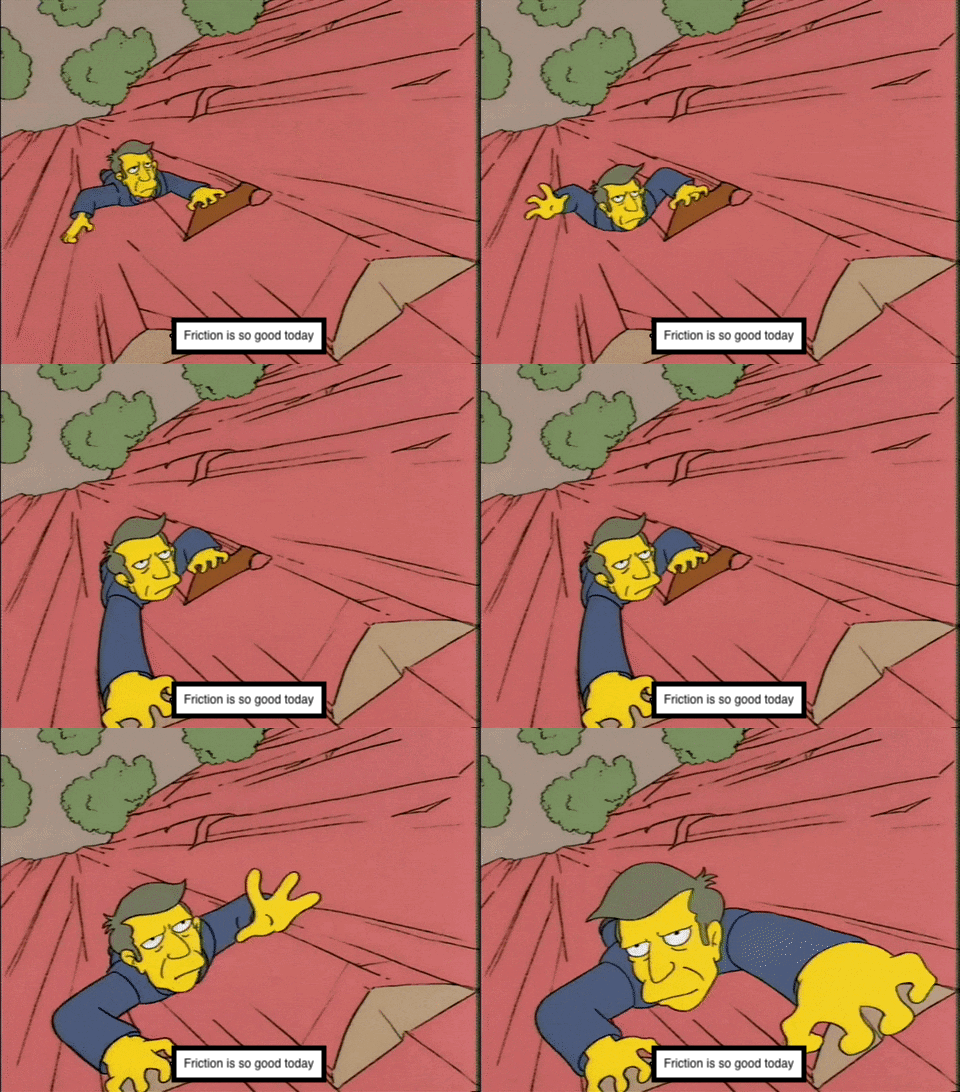
To a lesser extent, friction can be affected by temperature. There is some thought that this can be taken literally; i.e. the coefficient of friction between your skin and the rock is worse. What most people mean when they say friction in the context of climbing is something less scientific and more perceptual. How do the holds feel? Do they feel sticky or not? This depends on so many factors, one is temperature, but an often neglected cousin is humidity. Independent of external conditions (the temperature and humidity where you are today) are your personal conditions: your level of fatigue, the quality of your skin, and the godforsaken Kroger™ chalk you put on your hands. These personal conditions also affect friction.
Broadly speaking, your perception of how the holds feel is so multifactorial and with good tactics, I truly believe that good temps actually span a relatively broad range of external conditions. There is good observational data to support this. See the below plot of the relative dates of all V15/8C and harder ascents logged on 8a as of 01.01.2026. The ascents in the Southern Hemisphere are shifted by six months to correct for seasonality.
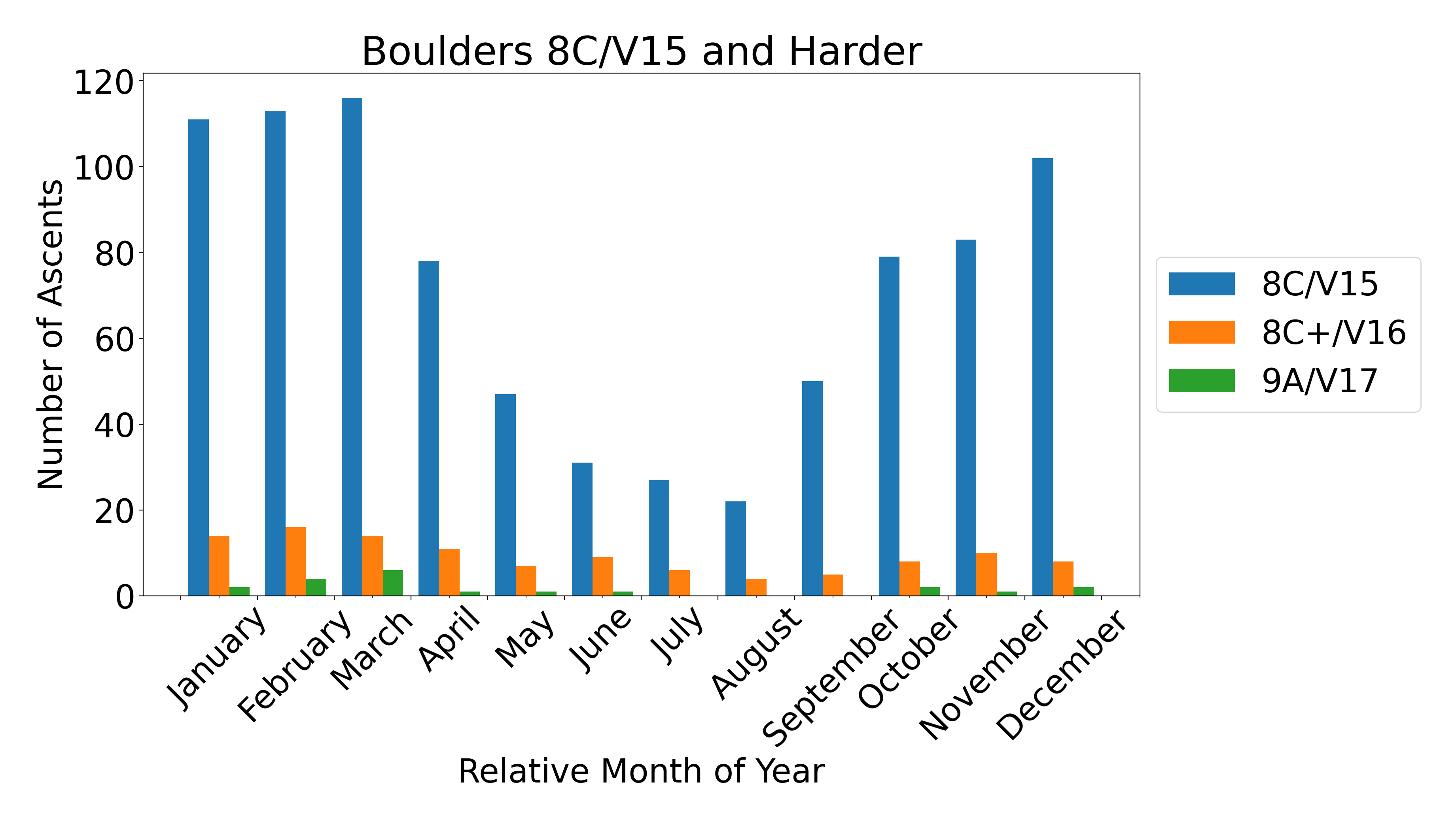
Of course, hard ascents cluster historically around winter but only weakly. Many still occur in the shoulder seasons spring/fall, and some even occur in summer months. Surprisingly, ascents of 8C+/V16 and 9A/V17 show even less of a pattern. This could be due to an insufficient sample size, but I argue that this further strengthens my thesis. Hard ascents can and do still occur in suboptimal temperatures. Thus, it is unreasonable for us to deem them necessary for hard climbing.
Recall Shawn Raboutou’s ascent of Megatron 9A in June 2022. Historical data of Eldorado Canyon State Park shows that the temperature in the month of June ranged from 3°C/38°F and 37°C/98°F with an average temperature of 20°C/69°F, and Chad mentions that it was 27°C/80°F that day, but they waited until the temps improved in the evening. It is reasonable to assume that the boulder was completed in temperatures between 16°C/60°F and 24°C/75°F. The reason I chose to discuss this ascent is that it was clear that Shawn was patient, he let his body get colder. This gave him the best opportunity to make the most of the day and the external conditions he was in by managing his body’s temperature.
Manage Core Body Temperature
There is the axiomatic solution of going to boulders when the external temperature is optimal, but this happens infrequently, and as previously discussed, this is not the strategy of the most successful climbers. What then?
My core guiding principle is to regulate core body temperature.
Hot Take
Your perception of friction, your skin, and to some extent your level of fatigue are all dominantly symptoms of your core body temperature.
The first step to doing this is to notice how your body feels. Are you actually mindful enough to answer “Am I hot/cold?” objectively. The extremities respond to core temperature. It drives me crazy when people say
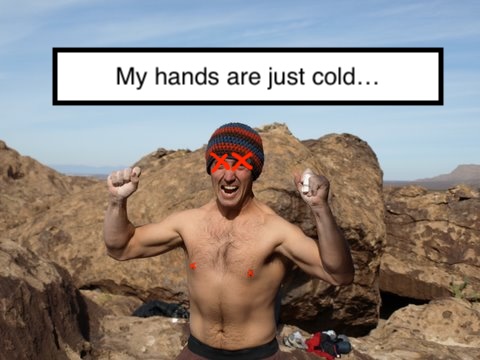
The sensation in your hands is largely a symptom of your core temperature. In extreme conditions direct exposure can play a role as well. The better part of valor may be to put on gloves, hike out, and enjoy the company of your wife/lack there of. Direct exposure to the elements is less relevant than core body temperature for most bouldering circumstances.
In a similar vein, obsessively fanning and chalking is likely an ineffective strategy. Your sweat is in response to your core body temperature being too high. If you only concern yourself with cooling your hands, then the second you leave the pacifier of your fan, the hands quickly sweat again. You must actually reduce your core temperature to have any lasting effect. Otherwise, you are limited to no more than two or three moves. Furthermore, cleaning the holds can often be a more pressing concern.
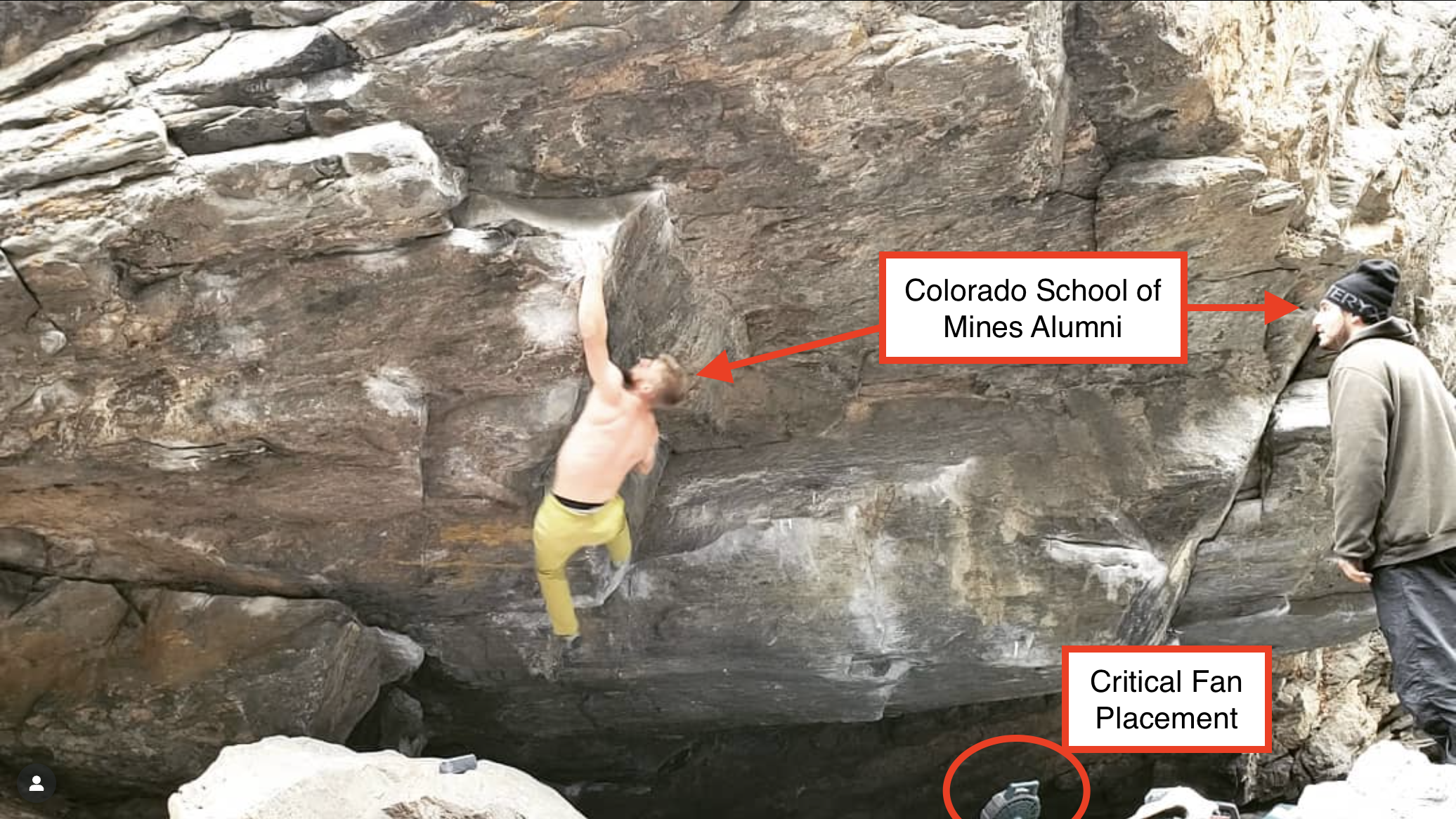
If you feel hot, the solution is to cool your core. Go sit in a dark cave. Take off your shirt. Get the trunk of your body in front of a fan. I have even started resorting to bringing an icepack to my session during summer months; I put the ice pack under my shirt in between burns. While this is effective, I (and everyone else) see this tactic as quite dorky. Don’t think you are going to win a popularity award because of your tactics 🤓.
Arguably, cold is more subjective than heat. Speaking in generalities, women vasoconstrict at warmer temperatures than men, leading to their optimal temperature being warmer than men. Just because your friends are shirtless, showing off their (aspirational) six-pack does not negate some people needing a jacket. Luckily, managing the cold is a solved problem. Mountaineers have done this for almost a century.
The minimum working example for cold bouldering is to have enough layers. Put them on when you are resting and take them off as needed when climbing. The goal being to stay as comfortable as possible the entire session. This minimizes the amount of energy you would have lost to the cold. It is important to bring layers that can be easily shed. Winter bouldering consists of taking cloths on and off all day. I prefer an oversized puffy, but I have also had success bringing a sleeping bag or a blanket to cover myself on the rest.
Resting
If you are trying a climb at your limit, you need to rest. Especially when giving red point burns, resting until you are actually able to give a full 100% effort is necessary. Even when finding beta, how will you know if a move is possible if you cannot give it a full effort? This starts the week and night before by sleeping (duh). In session, resting successfully boils down two components: wearing and using the appropriate clothing to managing your temperature, and actually sitting down someplace comfortable to get your heart rate lower and process the lactic acid (amongst other things) that you just accumulated from your last attempt.
Resting also gives you an opportunity to not only physically recover, but also mentally prepare to try hard again. If you think about it, trying as hard as we do when bouldering is quite rare in the human experience. In most contexts, adults rarely try harder than RPE 7 on damn near anything: at work, at school, even at the gym. I mostly try climbs 2-3 grade below redpoint at the gym. This decreases injury risk and allows me to increase work capacity. Thus, my outdoor sessions are uniquely intense. This wears on your mind and nervous system more generally as well.
The mind game off the wall during the rest is the crux of bouldering for me. Rest is not only to recover your muscles, organs, etc; rest also plays a critical role in preparing your mind and soul for the next attempt. Recently, I have convinced myself that the optimal strategy is to find a sense of mindfulness during the rest. This has led to the best results in my late twenties and now thirties. Once I am calm, then I can build back to a place where I can try my absolute hardest.
Earlier in life, I found some success by simply raging. Fueled by trap, caffeine, and every once in a while cigarettes 🚬 (Plz don’t tell my mom). I was convinced that a sense of urgency and dominance was necessary to conquer boulders. Now, I am not so sure. For me, pulling on with a clear and mostly empty mind leads to better results.
Nutrition and Hydration
I am a larger (thique) guy and tend to be overly concerned with my mass. There is truth to each person having a fighting weight, but it is also clear that pursuit towards this goal may lead to many negative consequences. For a more nuanced and complete understanding, I suggest watching the beautiful film Light. Back in 2020 I worked with Hailey Fultz, and more recently in 2024 I worked with Chauncey Carroll to adjust my nutrition. Overall, I think it is best that people seek profession guidance to dial in their diet. In any case, tactically, all you can control is how well fueled you are during your session and to some extent the days leading up to said session.
(Not So) Hot Take
Underfueling is worse than overfuelling.
It is not uncommon to hear people talking about wanting to stay light on the day, but I have watched people again and again lack the power they display during a training session simply because they do not eat on climbing days. This is absurd. Realistically, you could be 1-2kg heavier from eating and drinking. This pales in comparison to how much strength you loose when you are hangry.
The real tactical decision is to choose good foods and time them well in your session. I have found protein and fat dense foods should be eaten primarily before and after the session. Focusing on balancing salt, sugar, and water during the session is the name of the game. If you are not feeling your best, it is likely you are deficient in one of those three. In session, I am constantly taking small bites of simple sugars (gummy bears or fruit), drinking water, and drinking electrolytes (I am legally obligated to mention physivantage sendurex or flow 😜). If the session goes longer than a few hours, it is best to take a long rest, eat a real meal, and then return to gripping grabs.
Again, when you are resting, you should be asking yourself: “How do I feel?” “Do I need salt or sugar?” Or “do I just need to pee?” It sounds so simple, but for me, it so hard to slow down and actually be aware of what my body needs.
Skin
Managing one’s skin is a key ingredient to hard bouldering. Luckily for me, I tend to have good skin with little work, so I will try to keep this section short. It would be more interesting to hear from someone like Will Anglin who naturally has skin resembling Play Doh and yet somehow has managed to have brief moments where he still has great skin.
I think it is good to act from a core guiding principle and build strategies accordingly. First, let’s establish what optimal skin is.
Definition: Good skin
Referring to an even thique layer on the tips of the fingers which usually are on the harder side.
Obviously, splits and pink skin are manifestations of bad skin, but to a lesser extent if your skin is soft and uneven then the risk of abrasions increases and friction degrades. To this end, strategies can be grouped into optimizing skin growth and minimizing risk of abrasions.
I am a firm believer in moisturizing skin, and it is really hard to over moisturize, especially in the dry climates where climbing is popular. This was a revelation to me when Chase Martinez, Denver Heinz, and I applied Climb Skin every twenty minutes while watching Netflix in Bishop circa 2018. We reapplied five or six times a night. Over the course of our two week trip, none of us split, and our skin quickly became hard. Thus, I keep some moisturizer in my climbing bag and often apply as soon as I get chalk off my hands. While moisturizing everywhere is good, for hard bouldering the main focus is to get the tips as good as possible.
Diet is the next key consideration: if you are not getting enough protein then skin production degrades. If you are an unholy vegetarian (kidding), then this is of paramount concern. Like all things nutrition, it takes consistency and time for this to make a big impact. Thus, drinking one shake a week likely has no measurable effect, but if your average protein consumption increases, you can grow more skin. More importantly, your muscles will also recover.
In my opinion, managing risk of tearing skin mostly boils down to managing the number of attempts. Sanding your skin, cooling skin and hold with a fan, and other minutia matter but only on the margins. If you come into the session with good skin, pull only a few times, you likely leave with good skin.
That said, I have all the toys:
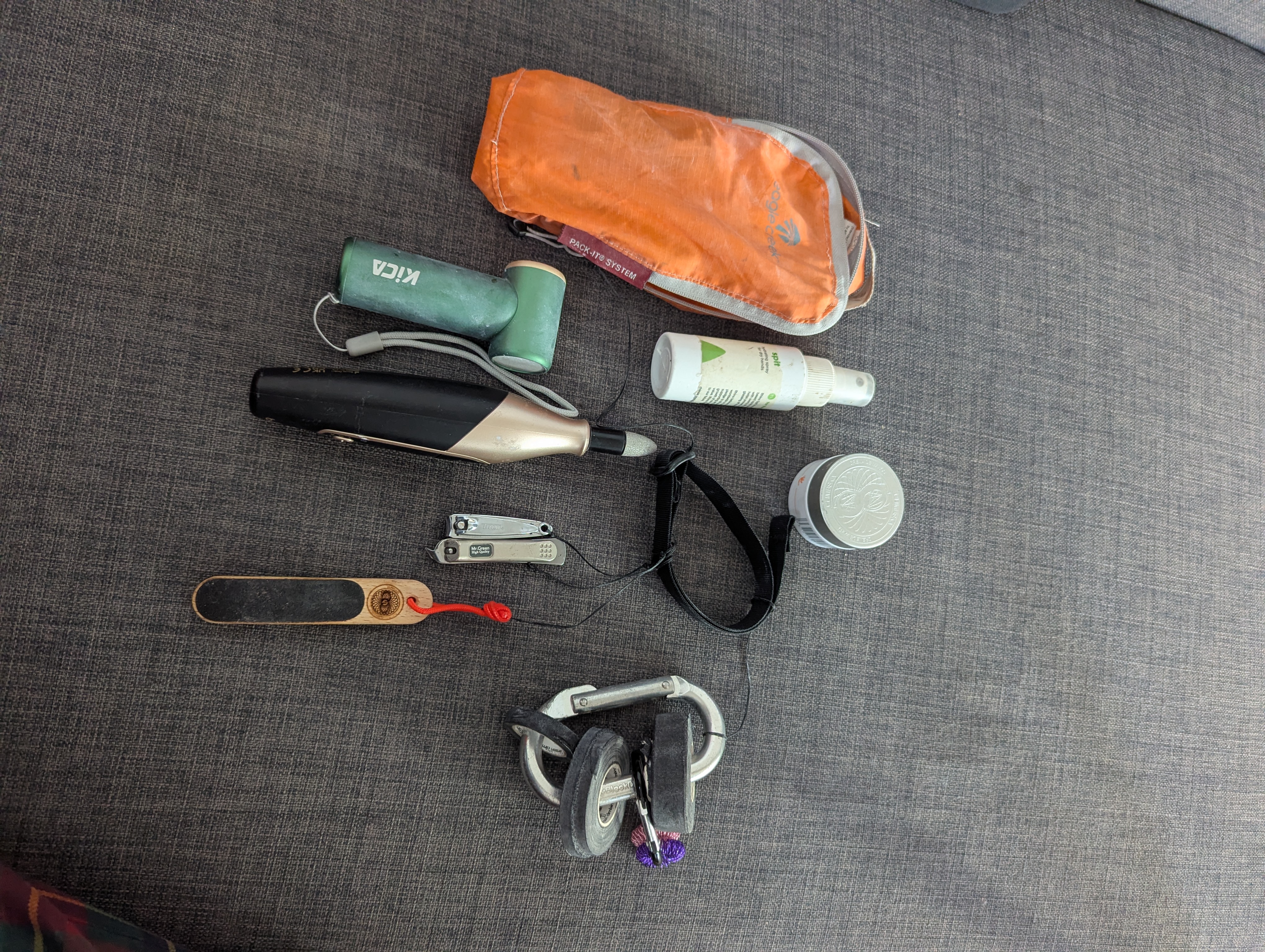
- My wife recently bought me a Bauer MP 84 electric callus sander. There are equivalent, more affordable options available. I still turn to manual implements so that I remove skin judiciously. Overall, sanding is over utilized in my opinion.
- I am wary of trimming with the ever ubiquitous straight razor blade because I got an infected cut from using a seemingly clean razor to trim skin while I was a university student. In response to this incident, my mother bought me a cuticle clipper from Mr. Green. These are superior to a simple razor or other implements because they have a small flat blade that you can be much more precise with. This all allows precision trimming, which is the name of the game.
- Rhino spit is a game changer, especially in cold and dry conditions. I find that it can be the last missing ingredient if my skin feels too hard. This is an edge case, so I need it infrequently. Even still, it is always in my bag.
- In recent months, I have forgone the legacy Makita fan in favor of a light weight Kica JetFan Mini. This is in response to my growing suspicion that moving air is actually of less concern than just getting your body’s core temperature correct and having clean holds. These jet style fans excel with regard to the latter. Its true strength lies in helping remove more particulates from the surface of the holds.
- Good tape is necessary to have in your kit, but arguably if you let your skin get to the point of tearing, the battle may still be won, but you are losing the war. Healing splits is a multi-day ordeal that interrupts trips and training. Avoid it. I honestly mostly use tape for dressing wounds elsewhere on my body and making gear repairs.
Hot Take
The best climbers hardly ever need to tape.
I’m not saying that genetic freaks like Noah Wheeler and Alex Megos don’t climb through tape, but arguably they are lacking self-control. If they managed their skin better, perhaps Noah would have sent Hypno and Megos would have climbed 9C.
Cleaning Holds
This is a relatively straight forward task, but there are few subtleties that are worth touching on. As mentioned previously, the jet style fans help. I like to brush while running the fan. This seems to be the way. A more streamlined solution appears to be the mµ stick which is an overengineered version of my ~350, but it is sexy as hell. So you best believe I am being good for Santa this year.
Bring a Rope
This truly opens a huge door for your ability to prepare for boulders. Especially if they are tall. A core memory that is foundational to my use of a rope comes from my Mother’s Day in Penitente trip. It was a memorable time with my mother, wife, and now mother-in-law. I wanted to climb this obscure high ball called Lean To. The climb clocks in around 7A/V6, but I was getting scared, and the falls were taking a toll on my body. My mom got frustrated with how long I was taking to send (classic), and said something to the effect of “If you are serious about doing this climb, you need to get the pine needles off the top out.” I ran back to the car and got my rope, rappelled down, got the holds clean, and sent first rip from the ground.
Rope tactics go beyond the scope of cleaning holds. It opens the door to rehearsing while solo, ticking holds, and beta finding in no-fall-zones. The real reason to bring a rope is risk management. If you want to do tall boulders, you best not fall very often. To this end, the rope allows you to effectively fall with zero consequences. The downside is that it is a hassle. For me, the complexity of utilizing the rope in the context of bouldering increases the appeal of the objective and can even be my favorite part of the session. This is likely not the case for many people.
Deep Cleaning
Using water, isopropyl alcohol, and possibly solvents to clean holds before you leave for the day is also an interesting idea that is starting to gain traction. This is tricky because depending on the rock type, getting the holds wet can significantly weaken the holds. Furthermore, using chemicals other than water can accelerate wear and tear on the rock considerably. Also, in general, you do not know if someone else is coming later on to also try a particular climb. How would you feel to show up and see your project wet? On the other hand, in high traffic areas periodic deep cleaning may be necessary. I would like to see more of a community effort in places like RMNP, Bishop, and Hueco to organize days when deep cleaning holds is done safely.
Tactics for Marginal Gain
Completely neglecting any of the aforementioned tactics is a blunder, but managing temperature, rest, nutrition, and hydration likely account for 75% of all the gain that tactics can give. Furthermore, if you manage skin and clean your holds, then you gain another 20%. Tactics beyond these core tenants are a mixed bag and can be more trouble than they are worth. Some are necessary but only in very specific circumstances. Also, an over-obsession with tactics may detract from the climbing experience for many climbers.
- Watching beta videos is a great example. There is something beautiful to coming to a boulder blind. Some people love this experience. Furthermore, I can often get locked into trying the beta rather than finding my beta. That said, I still watch beta. In general, I think discussion with climbing partners is a better tactic overall. This is (partially) why I am friends with such wonderfully talented climbers 😈. They feed me beta.
- Warming up is critical to a successful session, but there are a variety of valid approaches. Some warmup with portable hangboards and rubber band contraptions. While others find it sufficient to just try easier problems. There is not a one size fits all here, nor do I think I have a novel approach personally. Thus, I leave the door open for another person to describe the optimal warm up to me.
- I have played around with having a quiver of shoes. Recently, I have decided that it is best to bring one softer pair and one stiffer. Matt Fultz once told me that he stopped bringing more than one pair of shoes because he felt like it gave him an unnecessary excuse and led to him wasting time trying out different shoes rather than trying hard. There is truth in this. Sometimes by limiting your options you can force yourself to focus on what matters more.
- Keeping your shoes clean is important. Friction for your feet also matters. I keep Tension Shoe Spray in my kit and use it infrequently. It is more important to not walk off the pads with your climbing shoes on. It is crazy to watch good climbers stand in the mud with their shoes on. Idiocy (kidding [kinda]). All that said, many ascents get done by all shoe types in all kinds of conditions, so again it is likely best to not obsess about your shoes.
- Finding a good hang where you can rest well is not always possible. When it is, I often find it useful to deal with the hassle of moving away from the climb to make my rest count. This can mean crawling deeper into a cave in the summer or out of said ice box in the winter.
- Bringing a car ice scrapers can make winter bouldering possible. Well, that is if you like some manual labor in the snow. In any case, this often makes it into my kit during the months of December, January, and February.
- I just learned to attach my brush to a retractable lanyard from my new friend Paul Katterl. This is particularly useful on rope. Now, when you are cleaning holds, you need not worry about dropping the brush.
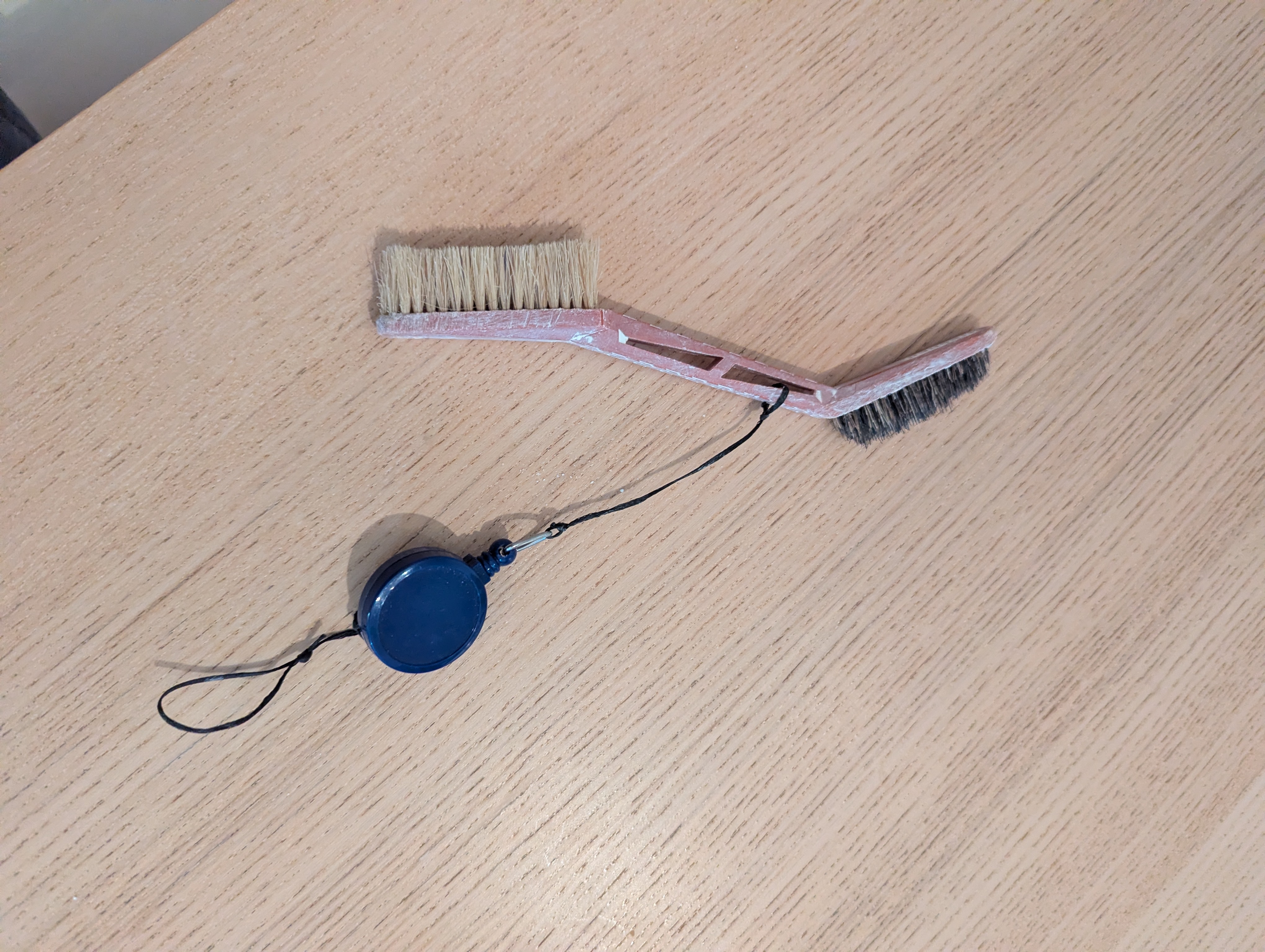
- Directing a fan onto a particular hold or to move air more generally has some limited utility. I found this useful when climbing on The Space Between Cars. There was a crimp that was particularly friction dependent (whatever that means). More recently, I used the same tactic on a climb in NÖ Hoccus Pocus because it was 90% humidity. In most conditions and for most holds, this is unnecessary.
- I also recently bought down booties with rubber soles made. Mostly out of jealousy. My friend Sam Struthers has some, and I finally caved. Hopefully my feet stay warmer while resting, and I am still able to move around the crag. Time will tell if it is worth the investment and the space in my pack.
- Proprane heaters are ubiquitous in the winter bouldering, but hiking a god-damn 7kg/15lb heater to the crag is almost useless in my opinion. I did so myself for years, but hopefully after reading discussion of core temperature you now understand that warming your hands on a heater does little to address the underlying issue at hand (see what I did there 😏). You need to get your core temperature up. Bring another jacket or a blanket. It is lighter and you burn fewer dinosaurs. People argue that they are useful for warming your shoe rubber, but a low tech and often better solution is to put the shoes in your armpits. You don’t want to risk melting your shoes, either.
- Lately, I have been bringing warm tea, and my Austrian friends have been hauling espresso making contraptions to the crag. Both are fun, and winter bouldering is little less uncomfortable as a result.
- For the last few years, I have also kept my fingernails slightly longer. At first, this did not work well because the nail would then get peeled back, but then I started applying clear nail hardener every two weeks or so. This made it possible to keep longer nails which maybe helps slightly with crimping. My thought is that the long nail gives your finger pulp more to press against. This likely could make very little difference as the fingernail is such a small aspect of crimping.
Acknowledgements
A huge shoutout to all my prereaders/reviewers: Paige Witter, Caroline Wicks, and Sam Struthers. The clean copy award goes to them.